The Whimsical World of Wacky Victorian-Era Holiday Cards
Wander back in time with us into the wonderfully weird world of Victorian holiday cards, complete with a few farmyard-themed flourishes.
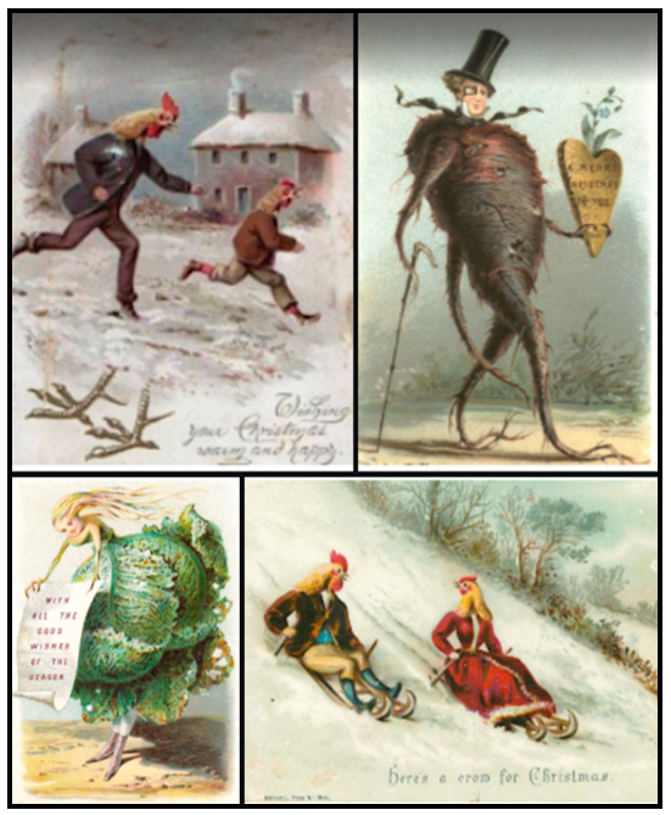
To get into the holiday spirit, one of our seasonal activities is exploring the traditions of the past. This inevitably brings us to one of our favorite pieces of holiday ephemera: the absolutely wild Christmas and New Year's cards of the Victorian era. Ranging from bizarrely delightful to downright morbid, these early seasonal correspondences were a far cry from the familiar visual identity of the holiday season we see in the U.S. today. (Note: The frolicking chickens and fashionable vegetables shown above are truly the tame ones!)
The first Christmas card is credited to Sir Henry Cole, a British civil servant, and was illustrated by John Callcott Horsley in 1843. With lithography becoming more efficient and affordable in the mid-1800s, Cole devised the idea of a mass-produced card as an expedient way to share holiday greetings with far-flung family and friends. While people had long sent handwritten New Year’s notes and other seasonal messages, the illustrated card offered a modern, efficient twist on an old tradition. His card, bearing the message “A Merry Christmas and a Happy New Year to You,” featured a Victorian family toasting the holiday, flanked by panels of charitable scenes. Although not widely accessible or affordable at first, advances in printing technology and reductions in postal rates over the following decades allowed the practice to spread. By the late 1800s, sending Christmas and New Year's cards had become a tradition across both Britain and the United States for those who celebrate.
So what explains the whimsical, surreal, and sometimes downright baffling imagery of some Victorian-era cards? Part of the answer is that the visual identity of Christmas was still developing - there was no shared playbook for themes or color palettes for that holiday. And New Year’s, with its broad observance and varied cultural expressions, allowed even greater freedom for playful or unconventional designs. Another factor was practical: printers often relied on stock lithographic plates because they were cheaper than commissioning new artwork (cue anthropomorphic animals, oversized insects, moral vignettes, and other fantastical scenes). Additionally, Victorian humor and aesthetics leaned toward the imaginative, the nonsensical, and the symbolically rich.
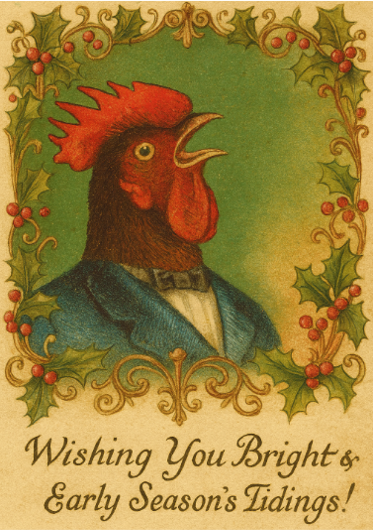
The collage of cards above includes some of our favorite farm-themed creations from that era. And as a seasonal greeting to you, and a nod to the creative traditions of holidays past, below is a DeFeo Family Farm original, starring one of our very first roosters dressed in his Victorian finest.